Foundations
Wyckoff's method rests on four axioms that cannot be bypassed without corrupting everything above them. What counts as valid evidence, what must be ignored, and why those rules are unconditional.
In This Post
- Purpose of This Document
- The Four Foundational Axioms
- Axiom L1-A: The Tape as the Primary Source of Truth
- Axiom L1-B: Judging the Market by Its Own Action
- What the Method Requires You to Discard
- Axiom L1-C: The Prohibition on Mixing Methods
- Axiom L1-D: Playing a Lone Hand
- Mental Logic Flow
- Connection to Higher-Level Concepts
- Common Errors Directly Traceable to L1 Violations
- Dependency Summary
Level 1 - Foundational Axioms Source sections: 2M (The Basic Law of Supply and Demand), 3M (Judging the Market by Its Own Action), 25M (Market Philosophy - Cautionary Suggestions)
Purpose of This Document
This file covers the four Level 1 concepts as a single cluster. They are separated in the concept map for cataloging purposes, but they form one foundational unit: together they define what kind of knowledge is valid, what the only acceptable source of evidence is, how to read that evidence, and what operational disciplines protect the reading process from contamination.
Every higher-level concept in the course - the three laws, the Composite Operator, the analytical methods, the phase structures, the decision framework - is built on top of this cluster. If any axiom in this cluster is violated, the higher-level machinery cannot function correctly, because the inputs it depends on are corrupted.
These four axioms are not guidelines or preferences. Wyckoff presents them in unconditional language: "UNLESS YOU DO THIS YOU WILL BE UNABLE TO GET THE BEST RESULTS" (Section 3M, Pages 3-4). The capitalization is his.
The Four Foundational Axioms
L1-A
- Concept: The Tape as the Primary Source of Truth
- Primary Source: 2M, 3M
L1-B
- Concept: Judging the Market by Its Own Action
- Primary Source: 3M
L1-C
- Concept: The Prohibition on Mixing Methods
- Primary Source: 25M
L1-D
- Concept: Playing a Lone Hand
- Primary Source: 25M
These four axioms address four distinct failure modes:
- L1-A: Using the wrong source (external data instead of tape)
- L1-B: Misreading the correct source (patterns instead of forces)
- L1-C: Contaminating the system with incompatible rules
- L1-D: Contaminating the judgment with other people's conclusions
Axiom L1-A: The Tape as the Primary Source of Truth
"Tape Reading and Chart Reading are merely methods of judging the market by its own action. We allow the tape (or the charts which represent it) to tell us its own story; and, by reasoning logically from the evidence thus presented, we are able to form our conclusions and thus arrive at our trading and investing decisions."
- Section 3M, Page 1
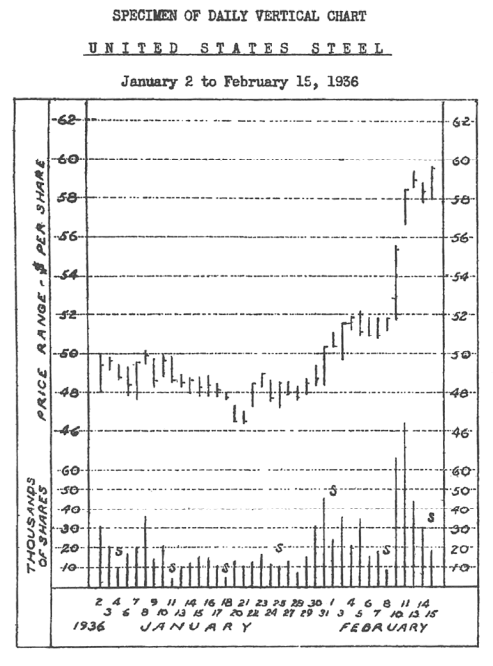
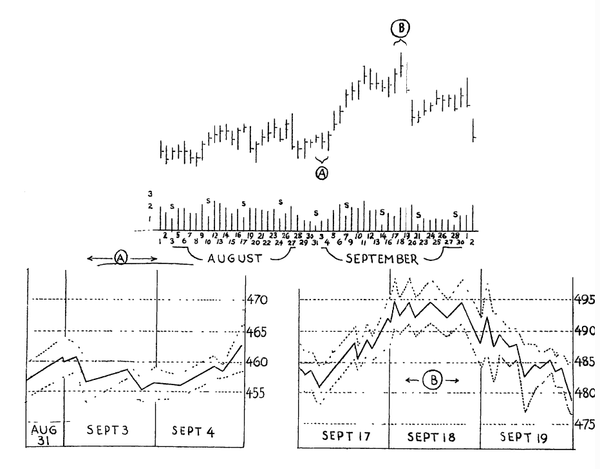
The tape is the record of every transaction in the market. Charts are its graphical representation - a translation of the tape into a form that can be studied and compared across time. Reading charts is therefore the same act as reading the tape, just more convenient. The source is singular: what happened on the tape.
The complete evidence chain is: tape -> charts -> logical reasoning -> conclusions -> trading decisions. There is no branch in this chain that accepts input from news, opinion, statistics, or any other external source. Everything that enters the analysis must come from the left side of this chain - from the tape itself.
Why the Tape Is Sufficient
"It is not necessary for you to consider any of these factors because the effect of all of them is boiled down for you on the tape. Thus the tape does for you what you are unable to do for yourself: it concentrates all these elements (that other people use as a basis for their stock market actions) into the combined effect of their buying and selling."
- Section 3M, Page 3
The sufficiency argument is not that external information is false. It is that external information is already incorporated into the tape. Earnings announcements, political events, crop reports, and bank statements all eventually cause participants to buy or sell. That buying and selling is what the tape records. The tape thus gives you the terminal result of all those factors - after they have been processed by every other participant in the market - which is what actually moves prices.
Reading the tape therefore gives you more relevant information than reading the source inputs, because you see the combined effect rather than having to interpret each input separately and predict how others will react to it.
"The tape is like a moving picture film. Every minute of the day it is demonstrating whether supply or demand is the greater. Prices are constantly showing strength or weakness: strength when buyers predominate and weakness when the offerings overpower the buyers. All the various phases from dullness to activity; from strength to weakness; from depression to boom, and from the top of the market down to the bottom - all these are faithfully recorded on the tape. All these movements, small or great, demonstrate the workings of the law of supply and demand."
- Section 3M, Page 2
The tape records every phase, every scale of movement, without omission. There is no market behavior that escapes the tape. This completeness is what makes the method closed: if the tape records everything, nothing outside it can add new information about the market.
What the Tape Specifically Records
Volume is part of the tape record from the beginning of the analysis:
"Tape Reading and Chart Reading, enable one to detect and profit by these inside operations or manipulation; to judge the future course of stocks, by weighing the relation of supply and demand. This sometimes can be done from price movement alone, but if you consider also the volume of the transactions you gain an additional and vitally important helpful factor."
- Section 3M, Page 1
Price movement alone is a valid partial read. Volume adds the measure of intensity -- how much force is behind the move. Together, they give the four facts (Section 3M, Pages 3-4):
- Price movement
- Volume - the intensity of the trading
- The relationships between price movement and volume
- The time required for all movements to run their respective courses
These four facts are the complete input set for every analytical method in the course (Level 4 through Level 9). Nothing beyond these four facts is needed. Nothing beyond them is permitted.
Axiom L1-B: Judging the Market by Its Own Action
The Probabilistic Claim
"No one can deny that the market is not always right - in fact it is often wrong. But no one can deny that those who know how to read the signs of the times are better equipped to judge which way the market is more likely to go."
- Section 3M, Page 1
Wyckoff does not claim his method produces certainties. He claims it produces better probabilities - "more likely to go" is the qualifier. This is the basis for all conditional language throughout the course. A Wyckoff indication is always a probability statement: given this evidence, this outcome is more likely than alternatives. It is never a prediction stated as fact.
This has a practical consequence: every indication the method produces is subject to revision if new tape evidence contradicts it. The analysis is never finished. The tape is always producing new evidence, and each new piece either confirms, modifies, or contradicts the current reading. The analyst updates continuously.
Reading Forces, Not Formations
"Whenever you study the tape or a chart, consider what you see there as an expression of the forces that lift and depress prices. Study your charts not with an eye to comparing the shapes of the formations, but from the viewpoint of the behavior of the stock; the motives of those who are dominant in it; and the successes and failures of the buyers and sellers as they struggle for mastery on every move."
- Section 3M, Page 2
This is the operational instruction for how to look at a chart. Three components:
-
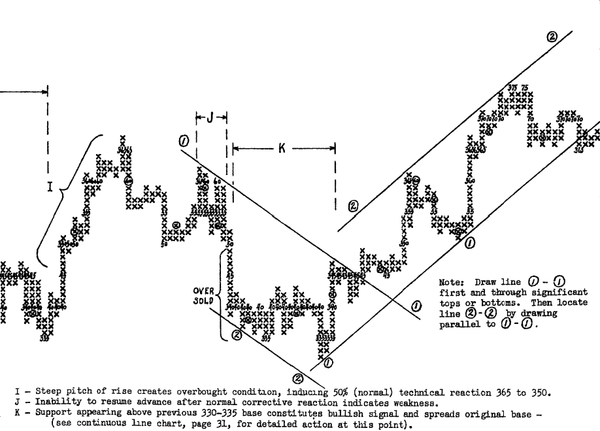
Forces: See price and volume as the result of competing supply and demand, not as geometric patterns. A triangle is not interesting because it is a triangle - it is interesting because of the balance of forces it represents and how they are resolving.
-
Behavior: Read what the stock is doing in response to its supply/demand environment, not what shape it makes. Two stocks can form identical visual patterns and have opposite behavioral meanings if the volume and the context differ.
-
Motives and outcomes: Ask who is dominant in this stock at this moment, what they are trying to accomplish, and whether they are succeeding. If a large interest is trying to accumulate and the price keeps refusing to break down despite repeated selling tests, they are succeeding. If the price breaks down on high volume, they are failing and the read changes.
This instruction is the direct refutation of Seventeen Errors #17 (pattern dogma: double tops, island gaps, etc.). Those errors arise precisely from studying shapes instead of forces - from looking at what the chart looks like rather than what the chart is saying.
Why Forecasting Works
"Coming events, I claimed, were foreshadowed on the tape because large interests there disclosed their anticipation of advances or declines by their purchases or sales."
- Section 2M, Page 2
The method is predictive because large interests are not passive. Before an advance, they must accumulate stock - which means buying into weakness over an extended period, creating the footprint of accumulation. Before a decline, they must distribute stock - which means selling into strength, creating the footprint of distribution. These necessary actions leave evidence on the tape before prices move.
This is why the tape can forecast: not because it contains secret information, but because purposeful large-scale activity cannot be hidden from the tape. The analyst who reads the tape correctly reads the accumulation as it is happening and positions before the markup begins.
"I saw more and more that the action of stocks reflected the plans and purposes of those who dominated them. I began to see possibilities of judging from the very tape what these master minds were doing."
- Section 2M, Page 1
Stock action is not random - it reflects purpose. When you read the tape, you are reading purpose. Not all tape action reveals purpose (Section 2M, Pages 1-2) - but the significant transactions do, and learning to separate significant from insignificant is the analyst's core skill.
"Each transaction carried with it certain evidence, although it was not always possible to interpret that evidence... Not all transactions were significant, but the interpreter must detect those which were. He must see that some indicated a purpose. Some one or some group was carrying, or attempting to carry, something through. He must take advantage of that."
- Section 2M, Pages 1-2
The Trend as Line of Least Resistance
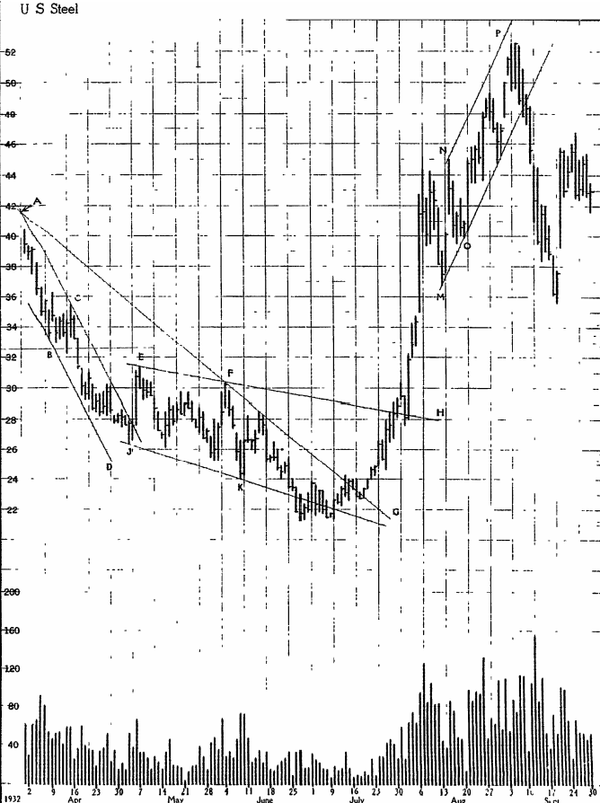
"The trend was simply the line of least resistance. When a stock met opposition in its rise, it must either be strong enough to overcome this resistance (selling) or it must inevitably turn downward, and when, in its downward course, sufficient buying was encountered to halt the decline, it would turn upward. The critical moments in all these various phases of the market were these minor and major turning points, or else the points where the price broke through the opposition into a new field."
- Section 2M, Page 2
Trend is a mechanical concept in Wyckoff's framework, not a statistical one. It is the direction of least resistance between opposing supply and demand forces. A trend continues as long as the dominant force has not been exhausted. It reverses at the point where the opposing force has built sufficient strength to overcome it.
The phrase "line of least resistance" is Wyckoff's formal term for trend throughout the course. When you see it in later sections, it always means this: the direction in which price moves with the least effort, because supply or demand is insufficient to block it.
What the Method Requires You to Discard
"...it is best that you prepare your mind for it by discarding most of the factors that you have heretofore employed in forming your judgment and making your decisions, such as: tips, rumors, news items, newspaper and magazine articles, analyses, reports, dividend rates, politics and fundamental statistics; and especially the half-baked trading theories which are expounded in boardrooms and popular books on the stock market."
- Section 3M, Pages 3-4
"I, therefore, claim that: You need never read anything on the financial page of your newspaper except the table of stock prices and volumes. You need pay no attention to the news, earnings, dividend rates or statements of corporations. You need never study the financial or the business situation. You need not understand railroad or industrial statistics, the money market, the crop situation, the bank statements, foreign trade or the political situation. You can absolutely ignore all the thousands of tips, rumors, reports and especially the so-called inside information that flood Wall Street. You can discard all of these completely and finally. UNLESS YOU DO THIS YOU WILL BE UNABLE TO GET THE BEST RESULTS FROM YOUR MARKET OPERATIONS."
- Section 3M, Pages 3-4
This is not a philosophical preference. Wyckoff frames partial compliance as operational failure: if you retain any of these inputs, your best results are blocked. The completeness requirement ("completely and finally") mirrors the sufficiency argument in Section 3M, Page 3 - if the tape already contains the terminal result of all these factors, retaining them in your analysis means you are processing them twice, but the second time (from the raw source rather than from the tape's result) introduces noise instead of signal.
The discard list has two categories:
- External information: news, earnings, statistics, politics, tips, inside information
- External theories: trading theories from boardrooms and popular books
The second category matters as much as the first. A trading theory that is not the Wyckoff method is, from the perspective of this method, external noise. It introduces decision rules that contradict Wyckoff's rules at critical moments. The Prohibition on Mixing Methods (L1-C) below addresses this directly.
Axiom L1-C: The Prohibition on Mixing Methods
"Our experience shows that those who set aside all other methods, ideas and theories (especially the Dow Theory) secure the best results... Therefore, we hope you will not mix our Instruction with any other for the above and the following reasons: It is practical, being founded, upon principles employed by real operators, men who have had professional experience... It is complete in itself. It covers all your requirements in all phases of the market."
- Section 25M, Pages 9-10
Wyckoff identifies two reasons for this prohibition:
-
It is complete. The method covers all phases of the market. There is no phase where a second method is needed to fill a gap. If you believe there is a gap, the gap is in your understanding of the method, not in the method itself.
-
It is founded on operator practice. The method derives from what real large interests actually do - not from academic theory or statistical patterns. Another method based on different principles will give different signals at the same moments.
The Dow Theory is singled out specifically because it was the dominant analytical framework when Wyckoff wrote. The problem with the Dow Theory in the context of this method is not that the Dow Theory is wrong - it is that the two systems have different timing rules, different confirmation requirements, and different signal hierarchies. At any critical moment, they may give opposite signals. If you follow the Wyckoff signal, you had no need for the Dow Theory. If you follow the Dow Theory signal over the Wyckoff signal, you have abandoned the method and introduced a different error model.
The same argument applies to any other system: Elliott Wave, support/resistance levels from fundamentals, seasonal patterns, or any other framework. The moment you accept a signal from a non-Wyckoff source, you are no longer operating inside the method.
Axiom L1-D: Playing a Lone Hand
The Core Argument
"Neither should you seek confirmation of your decisions by consulting others whom you may regard as experts, unless you are positive they speak the same language as you, that is, understand and follow the same principles. Even then, be careful."
- Section 25M, Pages 1-2
The problem with seeking confirmation is not that others are incompetent. Two skilled operators can hold diametrically opposed positions (one long, one short, in different stocks), both profit, and both be correct within their own frame of reference (Section 25M, Pages 1-2). If they compare notes, the result is confusion: one or both will modify a correct reading based on information that does not apply to their situation.
The contamination mechanisms:
- Time frame mismatch: An investor's opinion and a day trader's opinion are both correct for their purpose but incorrect for each other's purpose
- Stock knowledge mismatch: The person consulted has not followed the specific stock; their offhand opinion overrides hours of careful chart study
- Language mismatch: The other person may use Wyckoff terminology but with a different interpretive framework, or may use different terminology entirely
"In fact, we know of cases where two equally skilled operators have had diametrically opposed positions at the same time, one long, the other short, in different stocks of course. Both made profits. But had they compared notes, consulting each other for an opinion on the market, the outcome would have been confusion, hence opportunity lost and mental poise upset."
- Section 25M, Pages 1-2
The Emotional Discipline
"A stock market operator must be as hard boiled as a five-minute egg.; cold blooded as a fish; deaf to all gossip; blind to news; and dumb as a door knob when it comes to discussing the market with others."
- Section 25M, Page 2
Four sensory disciplines: deaf to gossip, blind to news, mute about your own positions, cold to the emotional temperature of the room. This is the psychological discipline that makes the intellectual discipline (the discard list, the prohibition on mixing methods) operationally sustainable. Without it, even an analyst who intellectually accepts L1-A through L1-C will leak information in and out of the analysis through informal conversations, market talk, and emotional responses to news headlines.
The Execution Rule
"NEVER ASK YOUR BROKER or anyone else what he thinks of the market, or what he advises you to do or whether he approves of what you plan to do. Form your own opinion."
At the moment of execution, when the temptation to seek a second opinion is strongest, the rule is absolute. Wyckoff uses the same capitalized NEVER that he uses for operational prohibitions in the decision framework. The broker's function is execution - getting your order into the market at the right price. The broker's opinion about whether to place the order is irrelevant and harmful.
"Once you have acquired complete control of your emotions, you will be surprised to find how greatly that strengthens your judgment. The better your judgment, the greater will be your confidence in yourself and your contempt for the opinions of others."
- Section 25M, Pages 1-2
The confidence Wyckoff describes is not arrogance - it is the natural result of operating from a single consistent framework that you have applied and verified. Confusion and self-doubt arise from mixed sources. A clean single-source method, applied consistently, produces a track record that you can evaluate against itself.
Mental Logic Flow
These four axioms define the analyst's complete operating environment before any chart is examined. The flow below shows how they gate every subsequent decision in the course.
Step 1: Establish the only valid input
- Accept that the tape (and its chart representation) is the sole source of evidence
- Discard all external information: news, statistics, tips, inside information (Section 3M, Pages 3-4)
- Discard all external theories: Dow Theory, popular trading systems (Section 25M, Pages 9-10)
- This step must be completed before looking at a chart - the inputs are filtered first
Step 2: Look at the chart with the correct analytical lens
- You are reading forces, not formations (Section 3M, Page 2)
- The question is always: what is the balance of supply and demand at this moment?
- The sub-questions are: who is dominant? What are they trying to do? Are they succeeding?
- The four permitted facts are: price, volume, their relationship, and time (Section 3M, Pages 3-4)
Step 3: State conclusions as probabilities, not certainties
- Every reading is "more likely" not "will" (Section 3M, Page 1)
- New tape evidence can confirm, modify, or contradict the current reading
- Update the reading when evidence changes - never defend a prior reading against contradictory tape evidence
Step 4: Work alone
- No external confirmation is sought (Section 25M, Pages 1-2)
- No positions are discussed with others (Section 25M, Page 2)
- Decisions are drawn from the charts, not from consensus
Step 5: Apply a single consistent system
- Every signal must originate from the Wyckoff method (Section 25M, Pages 9-10)
- If a signal from a non-Wyckoff source agrees with your reading, you had no need for it
- If a signal from a non-Wyckoff source disagrees, you must choose between systems - and that choice introduces a non-Wyckoff error at the most critical moment
This five-step gate applies every session, every trade, every review of a position. The gate is not a one-time initialization - it is the operating condition under which all analysis occurs.
Connection to Higher-Level Concepts
L1 is the prerequisite for every concept at every subsequent level. The specific dependency paths:
L1-A (Tape as Source) -> L2 (Three Laws) The three laws (Supply/Demand, Cause/Effect, Effort/Result) only have meaning if you accept that the tape record is accurate and complete. If you are also using external inputs, you can rationalize any tape reading with an external factor, which makes the laws untestable and therefore useless as analytical tools.
L1-A (Tape as Source) + L1-B (Judging by Own Action) -> L3 (Composite Operator) The Composite Operator is a useful fiction for the combined force of large interests. This concept only works if you accept (Section 2M, Page 1): action reflects plans and purposes. If you believe tape action is random or driven by unpredictable external factors, the Composite Operator framework has no predictive power.
L1-A (Tape as Source) + L1-B -> L4 (Analytical Methods) The four analytical methods (Wave Chart, Volume Analysis, Price/Volume Relationships, Comparative Strength) all operate on the four facts (Section 3M, Pages 3-4): price, volume, their relationship, and time. These four facts are only available if you have accepted L1-A (tape as source) and excluded external inputs that would contaminate the relationship.
L1-B (Judging by Own Action) -> L4-F (Figure Chart Analysis / Points of Resistance) Points of Resistance and Support (L4) are derived from the tape's own history - where supply and demand previously balanced and flipped. This concept depends on reading past tape behavior as evidence of future behavior, which is only valid under L1-B.
L1-D (Playing a Lone Hand) -> L9 (Execution Philosophy) The execution discipline in L9 (position sizing, emotional control, timing of entries) is impossible to maintain if the analyst is contaminated by external opinions. L1-D is the prerequisite for L9 to function. Many of the Seventeen Common Trading Errors are L9 failures that trace back to L1-D violations.
Common Errors Directly Traceable to L1 Violations
These are entries from the Seventeen Common Trading Errors (as cataloged in the concept map under Level 8/9). Each traces to a specific L1 axiom violation.
Error #2: Ignoring the market trend Axiom violated: L1-B (Judging by Own Action) The tape's overall trend is part of its own action. Ignoring it is ignoring the primary signal. The trend is the line of least resistance (Section 2M, Page 2) - it tells you which direction requires the least effort from the tape's own evidence. An analyst who ignores it is picking stocks in the wrong direction relative to the dominant force.
Error #15: Broker opinions contaminating decisions Axiom violated: L1-D (Playing a Lone Hand) The broker is consulted for a market opinion and the resulting advice overrides or compromises the chart reading. This is the exact failure Wyckoff preempts with the capitalized NEVER in his execution rule .
Error #16: Outside information - market letters, advisory services Axiom violated: L1-A (Tape as Primary Source) + L1-D (Playing a Lone Hand) An external advisory service (market letter) is accepted as a valid input alongside the tape. This violates L1-A by introducing a non-tape source, and L1-D by accepting another analyst's conclusions in place of independent judgment.
Error #17: Pattern dogma - double tops, island gaps Axiom violated: L1-B (Judging by Own Action) The analyst studies shapes instead of forces (Section 3M, Page 2). A "double top" is identified as a pattern and acted on because of the shape, not because of the behavioral analysis of supply and demand at those two tops. The behavioral analysis might support the same trade - but for entirely different reasons, and it would include volume and time considerations that the shape-only analysis omits.
Dependency Summary
Feeds Into
- L1-A: Tape as Primary Source → L2-A: Law of Supply and Demand
- L1-A: Tape as Primary Source → L2-B: Law of Cause and Effect
- L1-A: Tape as Primary Source → L2-C: Law of Effort and Result
- L1-A: Tape as Primary Source → L4-A: Wave Chart Analysis
- L1-A: Tape as Primary Source → L4-B: Volume Analysis
- L1-A: Tape as Primary Source → L4-C: Buying and Selling Waves
- L1-A: Tape as Primary Source → L4-D: Price/Volume Relationships
Feeds Into
- L1-B: Judging by Own Action → L3-A: The Composite Operator
- L1-B: Judging by Own Action → L4-E: Comparative Strength/Weakness Analysis
- L1-B: Judging by Own Action → L4-F: Points of Resistance and Support
- L1-B: Judging by Own Action → L5: All Campaign Reading concepts
- L1-B: Judging by Own Action → L6: All Phase Maneuver concepts
Feeds Into
- L1-C: Prohibition on Mixing Methods → L8: Decision Framework (all nine tests)
- L1-C: Prohibition on Mixing Methods → L9: Execution Philosophy
Feeds Into
- L1-D: Playing a Lone Hand → L8: Decision Framework (independent execution)
- L1-D: Playing a Lone Hand → L9: Execution Philosophy (emotional discipline)
All four L1 axioms -> every concept at every level. The axioms are not foundational in a pedagogical sense only - they are operationally prerequisite. Violating any of them at runtime degrades the reliability of every subsequent analysis step.